

Effective campus energy management serves as the foundation for modern universities aiming to reconcile ambitious sustainability targets with the realities of institutional finance. For sustainability directors and capital planning leaders, the challenge lies in the sheer scale of multi-campus systems. Individual buildings might chase LEED certifications, while the broader university system commits to aggressive carbon neutrality dates. Historically, these efforts operated in silos. Facilities teams focused on efficiency, while procurement offices chased the lowest kilowatt-hour price. This fragmented approach no longer holds up under the scrutiny of modern ESG reporting or the volatility of current power markets.
A unified strategy is the only way to protect the bottom line while advancing environmental commitments. You must treat electricity procurement, renewable energy credits, and LEED requirements as a single, cohesive portfolio. Doing so allows a university system to use its collective buying power to secure favorable terms that a single campus could not achieve alone.
The new reality: sustainability targets meet volatile power markets
University leaders now face a double-edged sword. On one side is increased pressure to decarbonize. On the other is a power grid that is increasingly unpredictable. Traditional procurement methods often fail to account for the long-term implications of green building standards. When a new research facility aims for LEED Platinum, its energy profile changes. If the procurement strategy remains rigid, the university might miss opportunities to hedge against price spikes or fail to secure the specific renewable attributes needed for certification.
Why LEED and carbon goals affect how you buy electricity
Renewable energy requirements within LEED frameworks dictate specific types of power sourcing. If your procurement office signs a standard brown power contract, the sustainability team must then scramble to purchase offsets or RECs separately. This creates a disconnect that often leads to higher total costs. Aligning the purchase of electrons with the pursuit of carbon points allows for more streamlined budgeting and clear progress tracking.
Risks of chasing green without a procurement strategy
Rushing into renewable energy commitments without a technical market analysis can lead to greenwashing accusations or financial instability. Some universities sign long-term power purchase agreements (PPAs) that look good on paper but include escalators that outpace market growth. Without a strategy, you might pay a premium for carbon reductions that do not actually count toward your specific institutional reporting frameworks.
Mapping LEED and carbon objectives to procurement levers
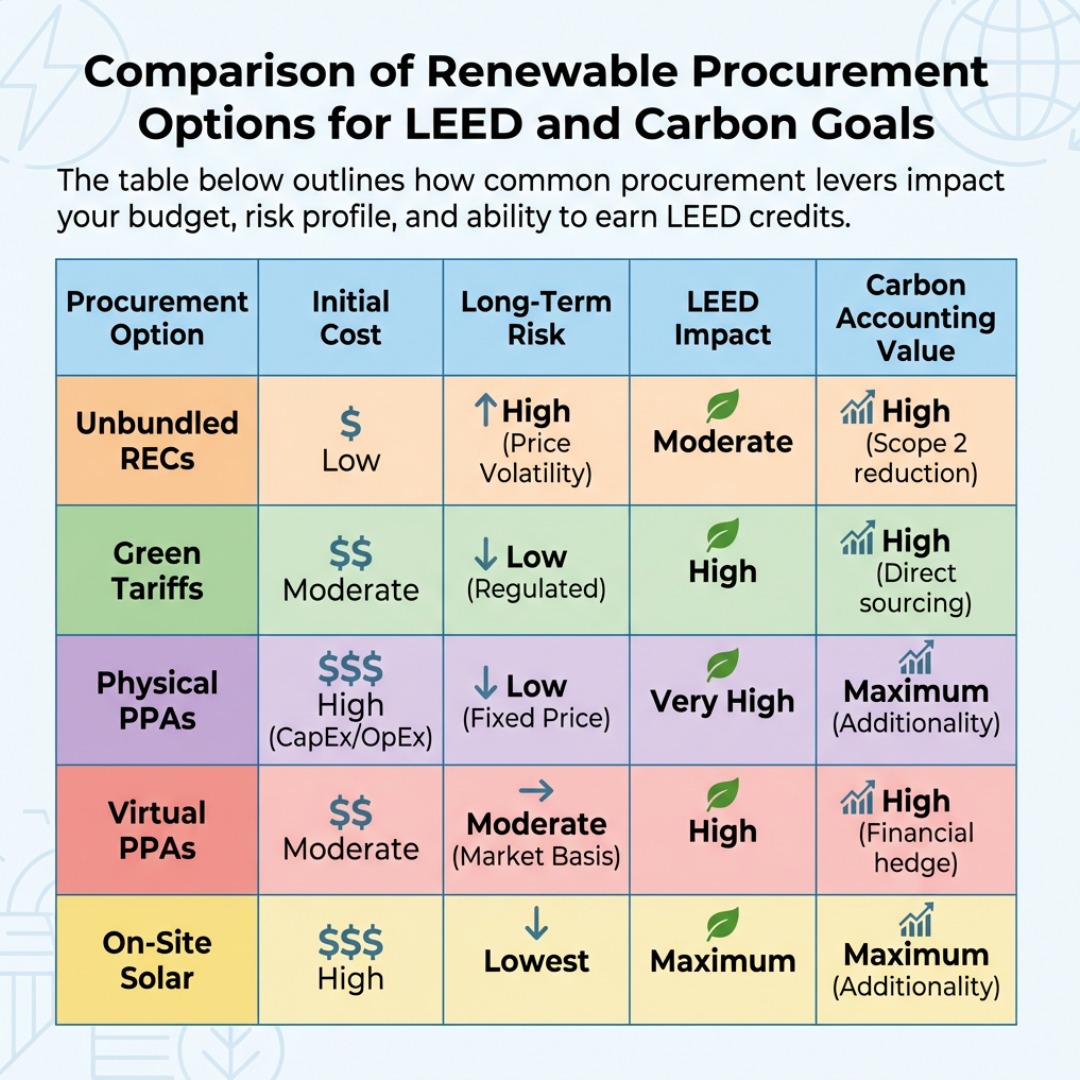
Successful campus energy management requires a deep dive into the various mechanical levers available in the energy market. It is not enough to simply want green power. You must understand the difference between bundled and unbundled products. Each choice carries a different weight in the eyes of LEED reviewers and carbon accounting protocols like the Greenhouse Gas Protocol. Selecting the wrong lever can result in spending capital on credits that offer zero additionality or fail to move the needle on net-zero goals.
Role of RECs, green tariffs, and bundled renewable products
RECs are often the quickest way to address Scope 2 emissions, yet they offer the least long-term price protection. Green tariffs provided by utilities offer a more integrated approach but can be limited by geography. Bundled products, where the energy and the environmental attributes stay together, provide the most robust defense for LEED points and carbon claims.
Contract length, risk, and certification timelines
Matching contract durations with the life cycle of a building project is vital. A ten-year PPA might provide the price stability needed for a decade-long carbon plan, but it requires a level of creditworthiness that requires board-level approval. Coordinating these timelines prevents a situation where a building loses its “green” power supply halfway through its certification cycle.
Coordinating across a multi-campus university system
Managing energy across multiple locations introduces a layer of complexity that can paralyze decision-making. Campuses often sit in different utility territories, meaning a strategy that works for an urban satellite campus might not apply to a rural flagship site. Effective campus energy management at this scale requires a framework that respects local constraints while leveraging the system’s total load. Centralizing the data while allowing for some regional flexibility creates a balanced approach to risk and reward.
- Standardizing data and metrics across campuses. Inconsistency is the enemy of a good carbon report. If one campus tracks therms and another tracks BTUs without a common conversion, the system-wide footprint remains a mystery. Establishing a single source of truth for energy data allows for fair comparisons and helps prioritize retrofits or renewable investments where they will have the greatest impact.
- Centralized vs. decentralized decision-making. Centralizing procurement often yields better pricing, but it can alienate local campus stakeholders who have specific operational needs. A hybrid model usually works best. The system office sets the carbon standards and negotiates the master power agreements, while individual campus leads manage local efficiency projects and demand response programs to meet those overarching goals.
Sample roadmap for a 5-year university power strategy
Building a resilient campus energy management program is a marathon. A five-year roadmap provides the necessary structure to move from reactive purchasing to proactive energy leadership. The first year should focus on data integrity and low-hanging fruit like optimizing existing contracts. As the strategy matures, the university can move into more complex structures like virtual power purchase agreements or on-site storage solutions that provide both resiliency and carbon reductions.
Short-term wins (REC strategy, contract adjustments)
Year one focuses on alignment. Auditing current contracts to find expiration dates and termination clauses allows for a clean slate. Purchasing high-quality RECs can provide an immediate boost to carbon goals while the longer-term infrastructure is planned. These quick wins build the internal political capital needed for larger capital requests in later years.
Medium-term moves (PPAs, on-site solar, storage)
Years three through five involve more significant physical and contractual changes. This period might see the execution of a physical PPA or the installation of a campus-wide microgrid. These moves transition the university from a passive consumer to an active participant in the energy market, providing long-term hedges against the rising costs of traditional grid power.
How Kb3 Advisors supports LEED-driven energy procurement
Navigating the intersection of energy markets and sustainability requires a specialized skill set that most university departments do not have in-house. Kb3 Advisors acts as the bridge between the sustainability office and the energy procurement department. We bring the analytical rigor needed to vet green energy claims and the market expertise to negotiate favorable contracts. Our goal is to make campus energy management a competitive advantage for your institution, rather than a mounting liability.
Here’s how we do it:
- Data-driven modeling of cost vs. carbon tradeoffs. Every green energy choice involves a tradeoff between cost, risk, and carbon impact. We provide the modeling to show exactly how a 100% renewable goal will affect the annual utility budget over the next decade. This transparency allows leaders to make informed choices that align with their specific risk tolerance and financial constraints.
- Advisory for executive and board-level decisions. Board members need clear, concise data to approve long-term energy commitments. We translate complex market mechanics into clear business cases. Providing this level of expertise helps university systems move faster and with more confidence, turning ambitious carbon goals into a documented reality that enhances the institution’s reputation.
Build a unified future for your institution
Effective campus energy management requires more than just efficient light bulbs or isolated LEED plaques. It demands a sophisticated alignment of procurement strategy, financial risk management, and environmental stewardship. When you unify these pillars across a multi-campus system, you transform a complex utility cost into a strategic asset that protects the budget and the planet.
Is your university ready to bridge the gap between sustainability targets and power market realities? Contact KB3 Advisors today to schedule a portfolio diagnostic and begin developing a resilient, carbon-conscious energy roadmap that serves your campus for the next decade and beyond.
Sources
- LEED credentials. usgbc.org/credentials. Accessed March 24, 2026.
- Energy performance of campus LEED buildings: Implications for green building and energy policy. researchgate.net. Accessed March 24, 2026.
- Green Power Pricing. epa.gov. Accessed March 24, 2026.
