

Energy contract risk assessment helps businesses understand what they’re committing to before an attractive supply rate becomes a binding financial obligation. A proposal might look competitive on its first page, yet contain provisions that change future costs, restrict renewal options or make it expensive to respond when business plans shift.
The lowest quoted rate doesn’t always represent the best overall agreement. Supplier contracts can include cancellation charges, pass-through provisions and renewal terms that affect what customers pay and how easily they can change arrangements. Those details deserve attention alongside the price.
An energy contract risk assessment is a structured review of pricing, contractual obligations, consumption assumptions and market exposure. It asks whether the agreement fits your organization’s financial objectives, operating plans and tolerance for uncertainty.
For CFOs, procurement leaders, facilities managers and commercial property teams preparing for a 2027 renewal, the practical question isn’t simply whether a supplier can offer a lower rate. It’s whether the full agreement supports a defensible purchasing decision.
Start with the contract, supporting schedules, recent invoices and an updated usage forecast. Then examine how the proposed terms would work under expected conditions and under circumstances your business would find harder to absorb.
Why energy contracts deserve a risk review before renewal
A commercial energy contract review should separate three connected sources of exposure. The first is market risk concerns. It changes in the prices or market-linked costs for which your organization remains responsible. Next is the contractual risk. It concerns the agreement’s obligations, exclusions, renewal provisions and remedies. Lastly is operational risk concerns, which can cause a mismatch between the purchasing commitment and how your facilities will consume energy.
These categories can overlap. A production increase might create additional market exposure if incremental consumption isn’t covered at the contracted price. A facility closure might raise contractual questions about cancellation or account removal.
Document which clause governs each situation rather than assuming the quoted rate answers every question.
Timing deserves the same attention. Begin the review early enough to obtain competing proposals, resolve unclear language and complete internal approvals before the earliest notice deadline. Don’t treat the expiration date as the only date that matters. Regulatory guidance highlights how renewal notices and the consequences of inaction can affect a customer’s next arrangement, although applicable protections vary by jurisdiction and customer category.
Kb3’s Energy Procurement Roadmap addresses portfolio-wide timing and purchasing coordination. This review has a narrower purpose, testing whether an individual agreement is suitable before it’s approved.
Evaluate fixed, indexed and blended pricing structures
Product labels are a starting point, not a substitute for reading the pricing schedule. Your review should identify what’s fixed, what can change and how each charge is calculated. An energy contract risk assessment should also consider how the proposed structure fits your organization’s budget expectations, consumption patterns and ability to absorb unexpected costs.
Rather than treating fixed, indexed and blended pricing as a simple choice between certainty and savings, examine the commitments behind each proposal. Which supply components does the quoted rate cover? What charges remain outside that rate? How would the agreement handle a meaningful increase or decrease in usage?
These questions help move the comparison beyond the initial price. Before choosing a structure, ask suppliers to explain their calculations using the same consumption forecast and contract period. Your team can then evaluate each offer against consistent assumptions and decide whether the remaining exposure fits the business’s financial priorities.
Fixed pricing
Fixed pricing can provide greater predictability for the supply component covered by the agreement. It doesn’t necessarily fix the entire electricity bill or remove every contractual adjustment. Pennsylvania supplier filings, for example, illustrate how agreements can contain provisions allowing certain additional costs to pass through to customers.
Ask the supplier to identify included charges, exclusions and adjustment rights in writing. Check contract duration as well. A longer commitment should be tested against lease terms, site plans and the period over which your consumption forecast remains credible.
Indexed pricing
Indexed arrangements link some or all the supply price to a specified market benchmark. For any proposed indexed product, request the exact index, settlement interval, applicable location, supplier fee and calculation method. Don’t assume that “variable” identifies a particular wholesale formula. State guidance distinguishes fixed and variable pricing, but the individual agreement still needs to explain how its price works.
Ask for a worked invoice example using your consumption profile.
Blended pricing
Blended arrangements combine fixed and market-linked elements. A block-and-index structure, for example, can fix a defined volume while leaving remaining consumption exposed to an index, subject to the contract’s settlement terms. Kb3’s procurement roadmap discusses this approach and the importance of matching fixed coverage to reliable load forecasts.
When comparing fixed vs. variable energy rates, test expected costs and an adverse case. The useful comparison is how each proposal fits your budget tolerance, not which label sounds safest.
Examine renewal deadlines and contract provisions
Create a timeline from the agreement itself, including amendments and account schedules.
Record the service start, expiration date, notice window, required delivery method and authorized recipient. Confirm whether the term follows calendar dates or utility billing cycles.
Next, establish what happens if your organization takes no action. Depending on the agreement and applicable rules, the next arrangement might involve different pricing or a renewal period. Pennsylvania guidance describes circumstances in which an expiring agreement can move to another fixed or variable arrangement. Don’t assume those rules apply to every commercial customer or market.
Early termination deserves a separate review. Supplier filings show that commercial cancellation provisions can use a calculation tied to remaining consumption and market value rather than a simple flat fee.
Ask for a worked example if the formula isn’t clear. Also examine assignment rights, supplier termination rights, notice requirements and any provisions relevant to a sale, relocation or account closure.
Maintain a centralized contract record with reminders well ahead of required decisions. Assign an owner and a backup.
Contractual rights vary by agreement, jurisdiction and customer classification. Have legal counsel interpret complex provisions before relying on a particular exit or renewal right.
Test contract assumptions against business operations
Historical consumption is useful evidence, but it shouldn’t become an unquestioned forecast.
Compare the proposed agreement with current plans for acquisitions, expansions, production changes, electrification, operating hours and facility closures. Review anticipated load changes and site plans rather than relying only on past consumption.
For each proposed contract, ask the supplier to explain whether it contains volume commitments or usage tolerances. Where those provisions apply, establish how consumption outside the permitted range is priced or settled.
Test specific operating scenarios:
- What happens if a facility adds a shift?
- Can a location leave the agreement when its lease expires?
- How would a prolonged shutdown affect the commitment?
- Can newly acquired accounts join, and on what terms?
- Does account removal change pricing for the remaining sites?
Request written answers tied to the relevant clauses
For multi-site organizations, review the account schedule line by line. Confirm service addresses, utility territories, account identifiers and proposed start dates.
A single purchasing approach shouldn’t be imposed without testing the differences between facilities. Geography, operating patterns, lease duration and load uncertainty are reasons sites may need different structures.
Use findings from your Year-End Energy Spend Analysis to challenge consumption assumptions. Pair that work with Energy Bill Audits for Businesses to check whether current invoices match the agreement before carrying existing charges into the renewal comparison.
Assess supplier and market exposure
Your energy contract risk assessment should examine the organization making the promise as carefully as the price being offered.
Request evidence of applicable authorization, identify the contracting legal entity and review available financial information. Ask who handles enrollment, billing disputes and account changes. Examine performance obligations, response requirements and contractual remedies rather than relying on service claims in a sales presentation.
Make supplier failure another review question. Establish the applicable utility or regulatory process, potential financial consequences and internal response responsibilities before approval.
Market analysis should remain specific to your service territories. Transmission congestion can affect location-based wholesale electricity prices, so a national price headline isn’t enough to explain a particular facility’s exposure. Pennsylvania regulatory materials describe how grid constraints can prevent lower-cost electricity from reaching an area and affect local pricing.
For a 2027 business electricity contract renewal, request a territory-specific explanation of the costs the supplier will absorb and those it can pass through. Review relevant utility commission information, market documentation and proposed change-in-law language without assuming a particular future price direction.
Compare offers using the same accounts, forecast consumption, delivery period and cost categories. If proposals treat a charge differently, make that difference visible instead of ranking offers solely on their headline rates.
Create an energy contract risk assessment checklist
Use five review areas to turn commercial energy supplier contracts into a decision record your finance, procurement and operations teams can share.
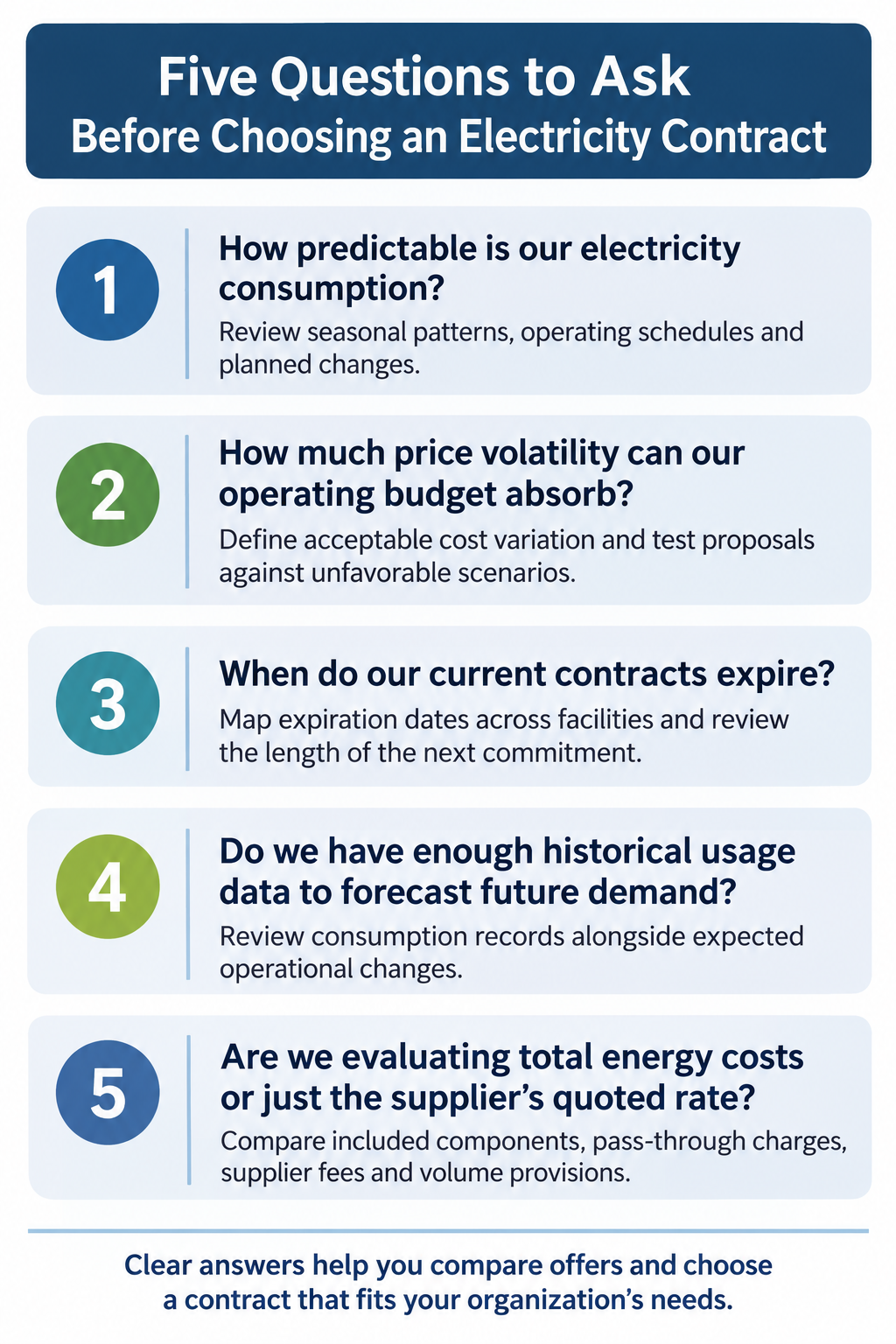
For each item, record the relevant clause, supplier explanation and supporting evidence. Mark the issue as acceptable, requiring clarification or requiring negotiation.
Escalate interpretation questions to legal counsel, budget exceptions to finance and operating assumptions to the facilities team. Don’t leave a material uncertainty buried in an email thread or treat an unanswered question as an accepted term.
Turn the assessment into a renewal decision
The review should produce a purchasing recommendation, not just an annotated contract.
Depending on the findings, your next action might be to request revised terms, seek competitive proposals, change the pricing structure, shorten the commitment or reconsider purchasing timing. Each option should address an identified concern.
If operational uncertainty is the main issue, ask suppliers to price clearer account-change rights or a different commitment period. If market exposure exceeds the approved budget tolerance, request an alternative structure and compare its cost. If an exclusion is unclear, obtain a contractual clarification rather than relying solely on verbal reassurance.
Document the decision in a concise approval memo. Include expected costs, material assumptions, reasons for rejecting alternatives, remaining exposure and the next review date.
This makes energy procurement risk management a repeatable approval process. It also gives future reviewers a record of why the organization accepted the terms.
Make the contract work for your business
A competitive rate matters. The contract determines how that rate works when consumption changes, deadlines arrive or additional costs arise.
An energy contract risk assessment gives your team a chance to identify those constraints before they become expensive commitments. The aim isn’t to eliminate uncertainty. It’s to understand which risks you’re accepting and whether they fit your business.
Kb3 Advisors’ electricity procurement services support supplier comparisons, pricing evaluation and contract negotiation. Our risk management services focus on identifying and addressing exposure in relation to financial objectives. Explore these services for help reviewing supplier offers and structuring your next procurement decision around your organization’s needs.
Sources
- Understanding Your Electric Supplier’s Contract and What To Look For As It Expires. puc.pa.gov. Accessed November 12, 2026.
- Factors affecting electricity prices. eia.gov. Accessed November 12, 2026.
- Volumetric Hedging in Electricity Procurement. berkeley.edu. Accessed November 12, 2026.
