
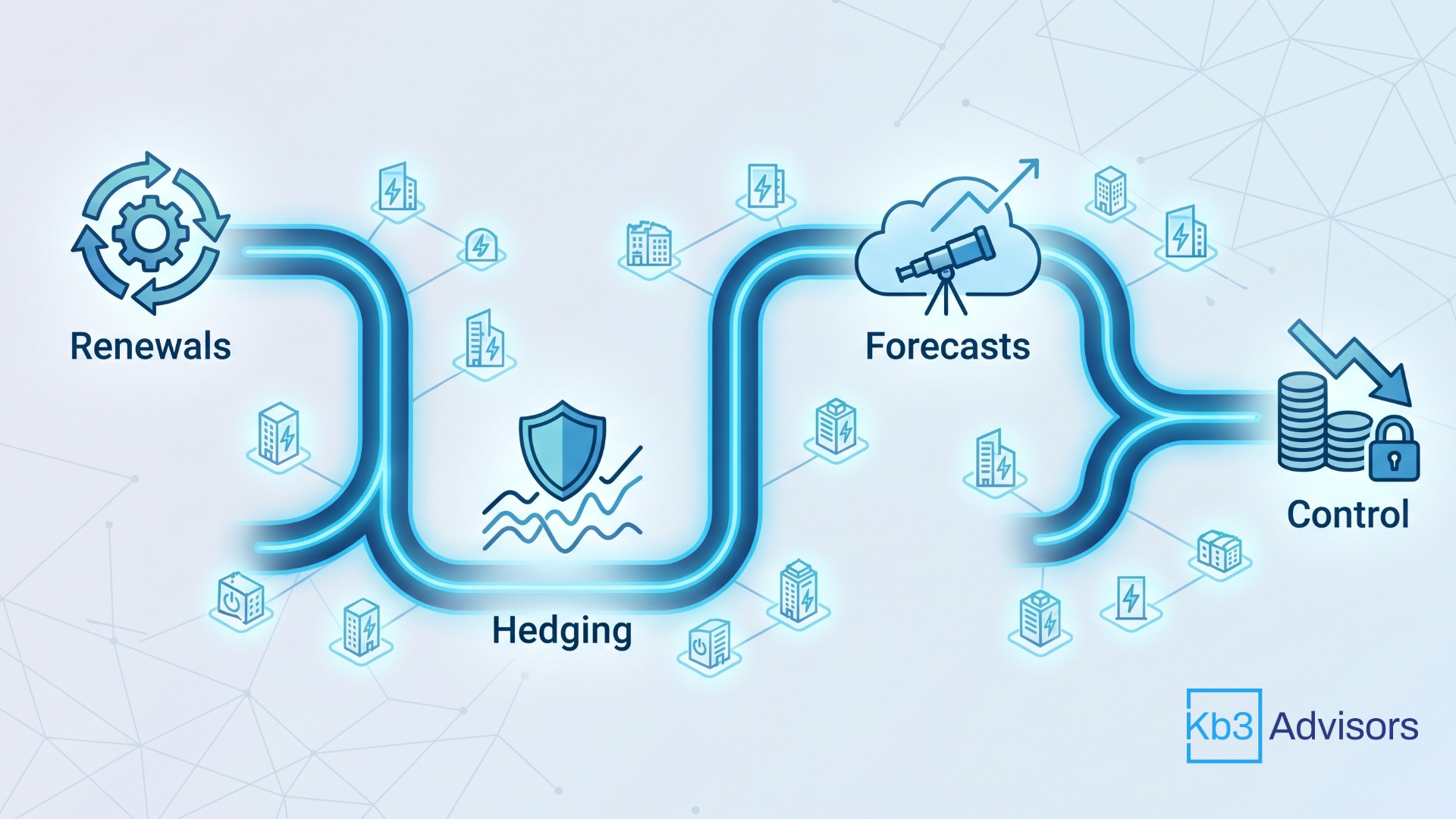
An energy procurement roadmap gives multi-location organizations a structured way to coordinate contract renewals, purchasing decisions, budget forecasting, and operational energy priorities over a three-year period. For companies with distributed facilities, energy procurement often develops one contract at a time. That approach can appear manageable until renewal dates cluster unexpectedly, pricing discussions begin under deadline pressure, and finance teams need a credible spending forecast for the next budget cycle.
Centralizing contracts and utility data is a meaningful first step. It improves visibility of suppliers, expiration dates, energy use, and invoice patterns across the portfolio. Still, centralized data alone doesn’t create a purchasing strategy. An optimized program requires a documented timeline for decisions, clear risk tolerances, differentiated plans for regions and site types, plus a budget model that shows what portion of future spend remains exposed to market movement.
A three-year plan creates space for informed choices. Procurement leaders can review contract terms before notice deadlines, group suitable accounts for a coordinated market event, and preserve different timing where geographic or operational differences warrant it. Finance teams can see a range of potential costs rather than relying on last year’s spend plus an assumed increase. Operations teams can identify sites that may qualify for demand response or merit demand-management investments.
The goal is not to call the market perfectly. The goal is to make consistent decisions that reflect the organization’s financial priorities, expected load, regional exposure, and appetite for price risk. For businesses moving from a centralized procurement program toward an optimized portfolio strategy, that discipline can reduce surprises and create a more reliable planning process.
Build your energy procurement roadmap from a complete portfolio baseline
A multi-year energy procurement plan begins with a reliable view of every account in the portfolio. Many organizations can identify their largest sites and current suppliers. Yet, they still lack a complete record of contract end dates, notice requirements, demand characteristics, tariff details, and expected operational changes. Missing details can cause a site to renew under pressure or lead decision-makers to apply the same product structure to locations with very different energy needs.
Create a portfolio inventory that includes site name, account number, utility, supplier, annual consumption, monthly usage pattern, peak demand, contract type, contract expiration, and any required renewal notice date. Add information about openings, closures, lease expirations, planned renovations, hours of operation, and expected load changes. These operational factors matter because an energy supply commitment should reflect anticipated use – not only historic consumption.
The inventory should also separate electricity and natural gas accounts where applicable. Electricity costs may include supply, delivery, demand, capacity, and other regulated charges. Natural-gas costs can involve distinct commodity, transportation, balancing, and utility-rate considerations. A credible forecast needs the right cost categories for each service and market.
Portfolio data should become a working management tool, not a spreadsheet updated only when a contract is about to expire. Quarterly reviews give procurement, finance, and operations a shared record of what has changed and what decisions are approaching.
Decide which renewals should align
Aligning renewals can help a multi-location business simplify administration and pursue stronger supplier competition. When comparable sites approach the market together, the organization can present a larger, clearer load profile and may have more consistency in contract terms, reporting requirements, billing processes, and internal approval workflows. Finance teams also gain a cleaner view of when major pricing decisions will affect the budget.
Not every account should share the same renewal date, term length, or procurement product. A retailer with sites in several utility territories may have different market conditions, capacity exposure, weather patterns, load profiles, and regulatory rules from one region to another. A warehouse with steady load may merit a different approach than a restaurant with high seasonal demand or a short remaining lease term.
An effective approach groups accounts where common timing creates administrative and commercial value, while retaining separate decision points when differences create unnecessary concentration of risk. This may involve short contract extensions for some accounts, though the potential cost and exposure of any extension should be reviewed first.
Centralized decision-making doesn’t require identical contracts. It requires a portfolio-level rationale for why contracts are aligned, staggered, fixed, indexed, or structured differently. That distinction helps organizations avoid treating coordination as uniformity.
Use staggering to diversify timing risk
Staggered renewals spread energy procurement decisions across several dates rather than placing the full portfolio into one market window. This structure is useful when an organization wants to avoid making a single, large pricing decision at a moment of heightened market volatility. It also suits portfolios that contain materially different site categories, regional exposures, or uncertain growth plans.
For example, a business may align its stable office locations within one utility territory while retaining different renewal timing for seasonal distribution facilities and stores in another market. This allows procurement teams to use a common governance framework without forcing unrelated load risks into one contract decision.
Staggering creates more ongoing management work. Teams need a reliable renewal calendar, documented decision rules, and regular communication with stakeholders. Without those controls, staggered dates can turn into a sequence of reactive deadlines. The difference lies in whether the dates are intentional and monitored.
An energy procurement roadmap should identify the purpose behind each renewal date. Some renewals may be grouped to aggregate volume and simplify reporting. Others may be separated to spread market exposure, accommodate different operating plans, or retain flexibility around uncertain site changes. The strongest portfolios use timing as a risk-management tool rather than allowing contract dates to develop randomly.
Structure purchases in layers
Layered purchasing divides procurement into several planned decisions over time. Instead of fixing all projected energy use in one transaction, an organization can purchase defined portions of expected load at different points before or during a contract period. This spreads the timing of market decisions and can make budget exposure easier to manage.
The percentage of load covered in each layer should reflect the reliability of the forecast. A stable baseload at a long-operating facility may support a larger fixed-price share than highly variable consumption at a seasonal site. A portfolio with planned openings, closures, or production changes may need more indexed flexibility until forecasts become more certain.
Layered purchasing doesn’t remove price risk. It changes the form of risk by reducing dependence on one purchase date and allowing the organization to revisit its position as markets and operational conditions change. It also gives finance teams a clearer way to understand the budget. They can see which portions of projected spend are fixed, which remains exposed to pricing movement, and when the next decision is scheduled.
A written procurement policy should guide layer sizes, approval thresholds, contract tenors, and market-monitoring practices. That policy helps prevent ad hoc decisions based on short-term price headlines or internal pressure near a renewal deadline.
Match fixed and indexed exposure to the load profile
Block-and-index pricing can provide a middle ground for organizations that want price protection for predictable consumption while keeping flexibility for variable load. Under this structure, a fixed-price block covers a defined amount of expected energy use. Remaining consumption settles against an index or market-linked price, subject to the agreement’s terms.
The right fixed block depends on more than annual consumption. Procurement teams should evaluate interval data, monthly demand patterns, seasonal variation, hours of operation, expected site changes, and the financial impact of over- or under-hedging. A highly predictable distribution center may support a larger block than a retail location with varying traffic, equipment loads, and weather sensitivity.
An indexed component can preserve flexibility, though it also creates exposure to future market prices. That exposure should be visible in the budget model and discussed with finance leaders before the contract is executed. The choice is not between certainty and uncertainty in absolute terms. It’s a decision about where the organization wants price certainty and where it can tolerate variability.
A well-designed energy procurement roadmap may apply different fixed and indexed shares across site groups. It should also define how the program responds when load forecasts, market conditions, or business plans materially change.
Build a 36-month budget forecast
A useful energy budget forecast estimates total cost, not only the price of the commodity. Commodity supply rates are important, but multi-location businesses also face utility delivery charges, demand charges, capacity-related costs, taxes, tariff adjustments, and consumption changes that can affect final invoices. These elements vary according to utility territory, market design, customer class, and operational usage patterns.
Build a rolling 36-month forecast with monthly consumption estimates for each site or site group. Mark the share of expected load under fixed-price agreements, the share exposed to indexed pricing, and the dates when additional purchase decisions will occur. Include known operational changes such as new locations, closures, lease transitions, equipment upgrades, production shifts, or altered operating schedules.
Present the forecast in three scenarios. The base case represents expected market and consumption assumptions. The high-cost case models higher commodity pricing, higher demand, capacity impacts, or unfavorable weather. The low-cost case reflects lower consumption or more favorable price conditions. This approach gives finance leaders a more useful planning range than a single point estimate.
Report the portion of projected spending that remains at risk. That metric communicates budget exposure in practical terms and helps leaders decide whether additional hedge coverage, demand management, or contract changes align with organizational priorities.
Account for capacity and demand response
Capacity costs deserve specific attention in regions where electric customers pay charges associated with maintaining resources for periods of peak demand. The calculation and timing differ by market and utility, so organizations should understand how their load contributes to capacity obligations and when peak-demand behavior can affect future charges.
Demand charges may also affect a site’s cost profile, particularly where short periods of high usage drive billed demand. A facility with modest total consumption can still produce significant costs if its operational schedule creates large peaks. Reviewing interval data helps teams identify whether operational adjustments could reduce demand exposure.
Demand response can become part of the financial plan for eligible facilities. Programs generally compensate or credit participants for reducing electricity use during qualifying events, subject to enrollment requirements, performance rules, and operational limitations. Participation can support grid reliability while creating a potential revenue stream or offsetting some capacity-related expense.
Facilities teams should determine which sites can curtail load without disrupting safety, customer service, production, or critical systems. Common measures may include adjusting HVAC settings, shifting nonessential processes, changing lighting schedules, or temporarily reducing discretionary equipment use. Every facility requires its own operational review.
Procurement, finance, and operations should evaluate these opportunities together. A budget forecast is more credible when it reflects not only purchased energy but also known demand-management options and the limits of those options.
Follow a three-year decision calendar
The first three months should focus on data quality, contract review, and governance. Confirm supplier agreements, notice periods, utility accounts, interval data availability, current pricing structures, and planned business changes. Assign ownership for procurement decisions, budget updates, contract review, and executive approvals.
Months four through six should establish portfolio segments and risk parameters. Determine which accounts can be procured as groups, which require separate treatment, and what percentage of forecasted load can be fixed at different time horizons. Create budget scenarios and identify potential demand-response sites before procurement deadlines become urgent.
During the remainder of year one, execute initial hedge layers or contract actions that align with the policy. Update the budget range as contracts are signed and market exposure changes. Keep a documented record of decisions, the assumptions behind them, and the dates for future reviews.
Year two should include regular forecast updates, additional procurement layers where appropriate, and reviews of tariff changes, capacity exposure, demand trends, and site plans. Year three brings focus back to upcoming renewals, but the work should be much more structured than a last-minute sourcing event.
An energy procurement roadmap stays active throughout the cycle. Quarterly meetings help teams compare forecasted and actual use, assess contract coverage, update assumptions, and prepare for decisions before timing becomes restrictive.
Create more predictable energy decisions
Organizations often can’t control wholesale markets, weather, utility tariffs, or every operational change that affects consumption. They can control the quality of their data, the timing of their decisions, the clarity of their risk policy, and the discipline of their review process. That’s it.
A centralized program provides visibility. An optimized program turns that visibility into coordinated action across contracts, purchases, budgets, and operations. It recognizes that the right strategy can differ across markets and site groups while still fitting within one portfolio-level plan.
For a retail chain, restaurant group, healthcare organization, manufacturer, or commercial real estate portfolio, the most valuable outcome may not be the lowest price in hindsight. It may be fewer surprise renewals, a clearer view of budget exposure, more consistent supplier terms – and a documented process leaders can explain and repeat.
Kb3 Advisors helps multi-location organizations develop energy procurement strategies that connect contract timing, layered purchasing, forecast modeling, and operational opportunities. A three-year plan can turn energy from a recurring deadline into a managed business decision. Give us a call to get started.
Sources
- Assessment of Demand Response and Advanced Metering. ferc.gov. Accessed August 17, 2026.
- Electricity procurement for large consumers based on Information Gap Decision Theory. sciencedirect.com. Accessed August 17, 2026.
- Benefits of Demand Response in Electricity Markets and Recommendations for Achieving Them. energy.gov. Accessed August 17, 2026.
