

Peak load reduction tools can help facilities manage a grid that’s become more volatile, less predictable, and more expensive. Sustainability leaders, energy risk teams, plant engineers, and technology operations managers can’t rely on a few people to watch weather forecasts and send last-minute emails asking teams to shut down equipment.
For years, many organizations followed a familiar approach to peak demand. They watched for hot summer afternoons, expected high grid demand, delayed discretionary processes, adjusted HVAC settings, turned off nonessential equipment, or ran backup generation when it made financial sense.
That approach worked when peak events followed more consistent patterns. Today, grid conditions can shift fast because of extreme weather, variable renewable output, large new loads such as data centers, transmission constraints, and changing utility pricing structures. Demand can peak outside the traditional late-afternoon window. It can also fall before an operations team has a chance to respond.
Modern energy management needs a more informed approach. AI demand management and predictive analytics can help facilities spot likely peak events earlier, assess available flexibility, and make measured adjustments without disrupting production, tenant comfort, data availability, or other critical operations.
The goal isn’t to cut load every time the grid looks stressed. It’s to reduce demand at the right time, in the right places, and at the right scale.
Why manual curtailment falls short
Manual curtailment depends on people, schedules, and assumptions. Someone has to spot a possible peak, decide whether the event calls for a response, contact the right stakeholders, and coordinate load reductions across equipment, buildings, or production lines.
That process creates delays at every step.
A facility manager might receive an alert late in the day and discover that the energy manager isn’t available. A plant supervisor may need more information before approving a change. A data center operations team may need to review redundancy requirements. A commercial building team may need to balance HVAC adjustments against tenant comfort. Industrial sites may need to account for batch timing, equipment ramp rates, safety procedures, and product quality.
Even companies with established demand response protocols can end up in a last-minute scramble. Teams need to move quickly, but they also need to avoid unnecessary disruption.
False alarms make the situation worse. A facility may curtail operations for a projected system peak that never arrives. The organization then takes on production inefficiencies, comfort complaints, labor costs, or missed operational opportunities without gaining a meaningful financial benefit.
Manual processes also can’t easily account for the volume of information that shapes modern peak conditions. Weather still matters, but it’s only one factor. Energy teams may also need to consider:
- Utility or ISO load forecasts
- Real-time interval meter data
- Building management system data
- Production schedules
- On-site generation availability
- Battery state of charge
- Electric vehicle charging demand
- Demand charge structures
- Capacity program rules
- Equipment maintenance needs
- Occupancy patterns
- Renewable generation forecasts
No one person can consistently evaluate all those signals in real time, especially across multiple facilities. Data-driven peak load reduction tools can help teams make faster, stronger decisions.
How AI improves peak load reduction tools
AI-enabled peak load reduction tools use data to improve decisions before and during potential demand events. Rather than following a static calendar or relying on a general rule like “curtail between 3 p.m. and 6 p.m. on hot days,” teams can identify patterns, forecast risk, and recommend or automate targeted actions.
Facilities don’t need to hand critical decisions to an opaque system. The best programs pair intelligent analytics with clear operational guardrails. Energy and operations leaders define which loads teams can adjust, which equipment must stay protected, how much demand they can reduce, and when someone needs to approve a change.
With those parameters in place, AI demand management turns a reactive process into a more precise operating strategy.
Predictive peak forecasting
Predictive peak forecasting gives organizations one of the most useful capabilities in modern demand management. Machine learning models can analyze historical energy use, local weather forecasts, real-time conditions, utility or ISO signals, and facility operating data to estimate when demand may rise.
That insight gives facilities more time to prepare.
An industrial facility may learn early in the day that a late-afternoon peak is likely. The operations team can move a flexible batch earlier, postpone noncritical equipment testing, pre-cool selected spaces, or charge a battery before the high-demand period. They don’t need to stop an important process at the last minute.
A commercial real estate portfolio can use forecasting to pre-condition buildings before a likely peak. Cooling systems can run more during lower-demand hours. That lets HVAC demand ease later without creating a noticeable decline in tenant comfort.
A data center can use predictive insights to coordinate battery assets, cooling plant settings, and noncritical workload scheduling while protecting uptime requirements.
Forecasting gives teams more confidence. Instead of responding to every possible event, they can focus on events with the greatest potential financial impact.
Interval data analytics
Most organizations collect more energy data than they use. Interval meter data, often captured in 15-minute or hourly increments, shows how demand changes throughout the day. When teams pair it with operational data, it can reveal the equipment, processes, or schedules that drive a facility’s highest kW readings.
Interval data analytics helps teams answer practical questions:
- Which hours create the highest demand charges?
- Do HVAC systems, production activity, charging, or simultaneous equipment starts drive the peaks?
- Which loads can teams adjust without disrupting operations?
- How often do short demand spikes create avoidable costs?
- Does one site account for an outsized share of portfolio demand exposure?
- Do efficiency measures reduce total kWh while leaving peak kW largely unchanged?
Those distinctions matter. A facility can lower its overall energy use and still pay high demand charges if it draws a large amount of electricity during a short period. Energy efficiency remains important, but demand management needs its own strategy.
Peak load reduction tools make interval data easier to act on. Instead of reviewing spreadsheets after the billing period ends, energy teams can receive timely insights that point to specific demand drivers and improvement opportunities.
Smart building energy automation
Insight alone won’t reduce demand. Smart building energy automation connects analytics to building management systems, industrial controls, distributed energy resources, and other equipment.
The system can carry out pre-approved adjustments when conditions meet defined thresholds. A facility might adjust HVAC setpoints, change chiller staging, delay EV charging, reduce lighting in unoccupied areas, adjust thermal storage, discharge a battery, or shift flexible processes.
Automation doesn’t have to mean an all-or-nothing shutdown. Incremental changes often deliver stronger results with less disruption.
A 2% adjustment across several systems may reduce demand enough to avoid a costly peak while preserving business operations. That option often creates less risk than abruptly turning off a major load and causing a much larger operational impact.
Dynamic load shedding works best when teams tailor it to the facility. Hospitals don’t have the same priorities as distribution centers. University campuses face different constraints than manufacturing plants. High-availability technology environments can’t tolerate actions that affect resilience or service delivery.
The strongest peak load reduction tools account for those differences. They identify flexible load, rank actions by impact and risk, and follow the limits set by facility leadership.
Operational constraint awareness
Energy decisions can’t ignore operating realities. A recommendation may look appealing in a utility data set but create problems if it interrupts a production run, affects product quality, creates safety concerns, or causes unacceptable tenant conditions.
AI-powered systems can factor operational constraints into the decision process. Teams can identify equipment that must remain online, set minimum comfort ranges, establish production thresholds, account for maintenance windows, and define approval workflows for higher-impact actions.
That makes demand management more useful for the people who keep facilities running.
Consider a plant with a large compressed-air system, process cooling equipment, and electric material handling equipment. The site may have several load-reduction options, but each carries a different level of risk. Temporarily adjusting a noncritical ventilation schedule may work well. Interrupting a process cooling cycle could create unacceptable consequences.
Constraint-aware automation helps organizations prioritize lower-risk actions first. It can also show when a facility doesn’t have enough flexible load to make a meaningful reduction. Energy and operations leaders can then make better-informed decisions about battery storage, on-site generation, process upgrades, or schedule changes.
The financial case for smarter demand management
Peak load reduction tools can create value in several ways. Demand charges often provide the clearest savings opportunity. Many commercial and industrial rate structures charge customers for total energy use in kWh and for the highest level of power drawn during a billing period, measured in kW.
A short demand spike can drive a substantial share of the monthly bill.
Facilities can lower those charges when they reduce peak demand, especially if their operations create high load variability or start large equipment at the same time. Predictive tools can also help organizations improve performance in utility demand response and capacity programs when those opportunities fit their energy strategy.
The value doesn’t stop at utility bill savings.
A well-designed program can reduce operational disruption. Rather than taking broad curtailment actions whenever a possible event appears, teams can make smaller, better-timed adjustments. That helps protect productivity, customer experience, and employee workloads.
Smart energy automation also improves visibility. When organizations see the connection between operations and demand spikes, they can make stronger capital-planning decisions. Data may show that staggered equipment starts could reduce a recurring peak without major capital investment. In other cases, the analysis may support investment in battery storage, advanced controls, HVAC modernization, or more flexible production scheduling.
Peak management can also support broader sustainability goals. Grid emissions can change throughout the day, depending on the generation resources serving the system. Reducing or shifting load during stressed periods can align energy decisions with resilience and decarbonization priorities.
Each facility needs its own analysis. A useful program starts with actual load data, applicable rate structures, operational requirements, and available flexibility. Generic recommendations can generate ideas, but a facility-specific plan will produce stronger results.
Where to start with AI demand management
Organizations don’t need to replace every energy system at once. A practical first step is to identify where demand risk is highest and where flexible load already exists.
Energy and operations leaders can start with a few focused actions:
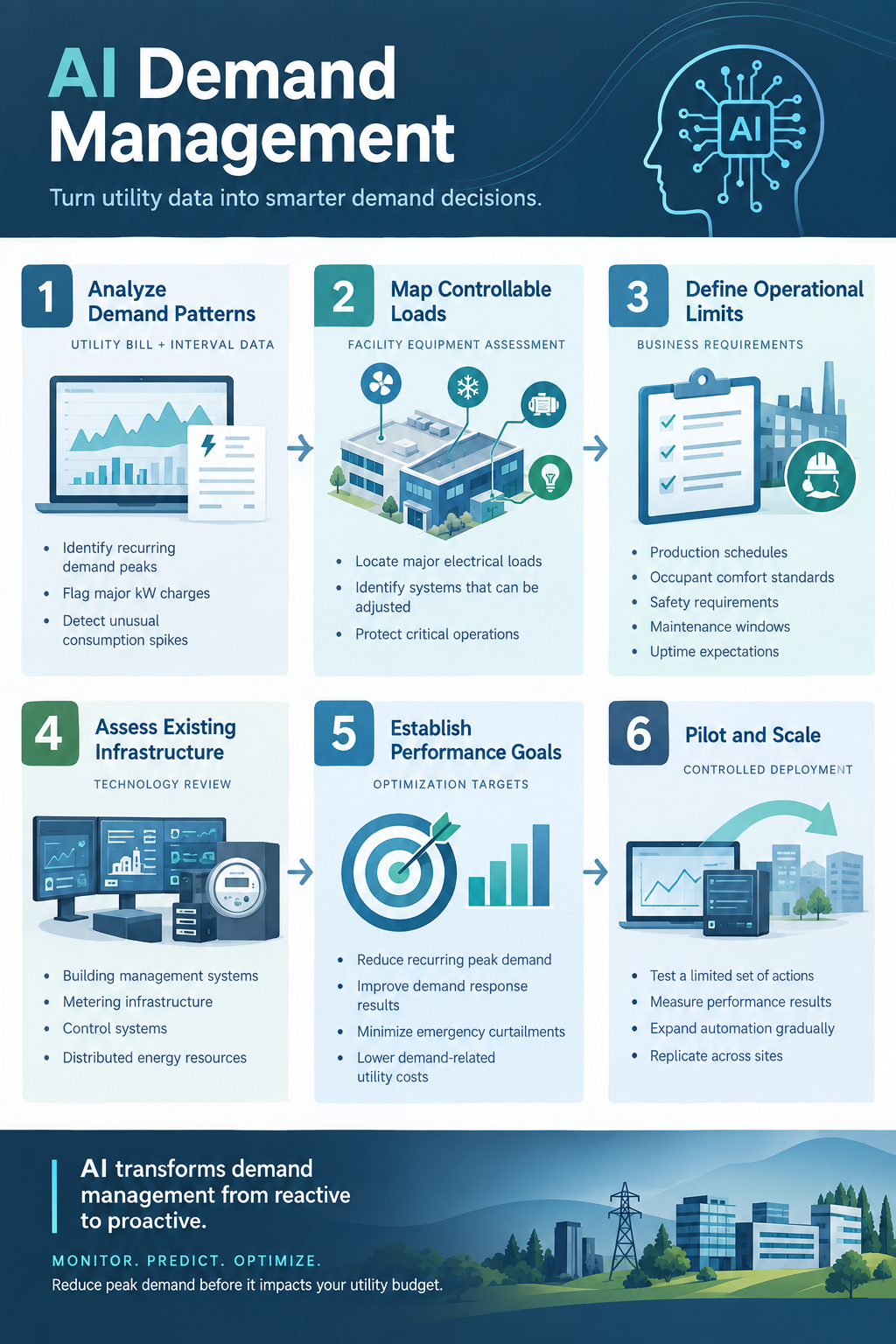
This approach helps teams build trust in the data and the control strategy. It also lets facilities demonstrate value before making a larger investment.
For many organizations, coordination poses the biggest barrier. Energy, sustainability, facilities, operations, finance, and IT teams may each control part of the data or decision-making process. A successful demand management program gives everyone a shared view of the opportunity and creates clear rules for action.
Turn peak management into a strategic advantage
Peak demand shouldn’t force your team into a recurring operational scramble. With the right data, controls, and operating rules, peak load reduction tools can help your facility anticipate high-cost events, make targeted adjustments, and protect the work that matters most.
Kb3 Advisors helps organizations connect energy procurement, sustainability strategy, operational data, and energy management technology. Whether your organization wants to control demand charges, strengthen demand response performance, assess smart building energy automation, or build a more resilient long-term energy plan, our team of energy procurement specialists can help you identify practical next steps.
Talk with Kb3 Advisors to turn your interval data and operational flexibility into a demand management strategy that supports cost control, reliability, and sustainability goals.
Sources
- 2024 Assessment of Demand Response and Advanced Metering. ferc.gov. Accessed October 5, 2026.
- AI for Energy. energy.gov. Accessed October 5, 2026.
