

Campus energy management is entering a new phase where data and flexibility redefine value. Traditional school district energy aggregation programs focused on pooling demand to gain volume discounts. While that was effective in early energy procurement initiatives, it no longer addresses the real drivers of cost and risk in today’s energy markets. Districts now face complex pricing structures that reward strategic consumption and penalize unmanaged peaks.
A modern approach to K-12 electricity procurement begins with understanding each campus’s load profile – hourly usage patterns that reveal when and how energy is consumed. When districts share this information collectively, they can attract suppliers willing to price energy more competitively and design products that match operational behavior. Combining data-driven insights with smart use of storage, solar, and building controls transforms aggregation from a buying group into a strategic partnership.
Kb3 Advisors helps consortia and public-sector leaders evolve aggregation programs into precision tools for better pricing, transparency, and long-term fiscal control.
The limits of first-generation energy aggregation
Early programs grouped districts under one large supply contract, assuming scale alone would produce savings. Today, that approach often leaves value on the table. Energy markets reward precision, not just volume. Without visibility into demand timing or flexibility, suppliers often add premiums to cover unknown risks.
A forward-looking campus energy management program recognizes that energy procurement is no longer a one-size-fits-all exercise. Districts differ in building schedules, equipment use, and efficiency levels. Those differences affect hourly load patterns, capacity charges, and overall competitiveness in public sector energy bidding. To unlock deeper value, aggregation needs smart design anchored in reliable operational data.
Volume without strategy: why some groups underperform
Groups that aggregate demand without analyzing usage patterns often pay blended rates that hide inefficiencies. High-peak users can drive up capacity costs for all participants. Without segmented load data, energy suppliers price the entire block conservatively to protect themselves. In this environment, volume alone cannot offset pricing uncertainty.
Effective school district energy aggregation relies on transparency among participants. When each member understands how its consumption contributes to the group’s profile, programs can reward efficiency and balance cost exposure across districts.
How suppliers price risk into blind aggregated loads
When suppliers cannot see hourly usage data, they must guess how the aggregation consumes energy throughout the day. This blind profile leads them to add premiums for potential peak risk, unpredictable usage, or seasonal variability.
In K-12 electricity procurement, that can mean higher fixed costs and fewer product options. Sharing interval data helps remove that uncertainty. Once risk is visible, suppliers sharpen bids and customize contract terms that align with actual load shape – creating more stable, cost-effective agreements.
The new drivers of aggregation value
Modern aggregation programs center on actionable data rather than just bulk buying. A data-driven campus energy management approach uses interval data, load segmentation, and automation to reshape procurement outcomes.
As energy markets evolve toward dynamic pricing, timing and flexibility become critical. Districts that shape load profiles to match off-peak periods can capture better rates. Adding controllable storage or on-site generation allows groups to respond to signals that lower system costs and supplier risk. Together, these capabilities redefine what success looks like in public sector energy bidding.
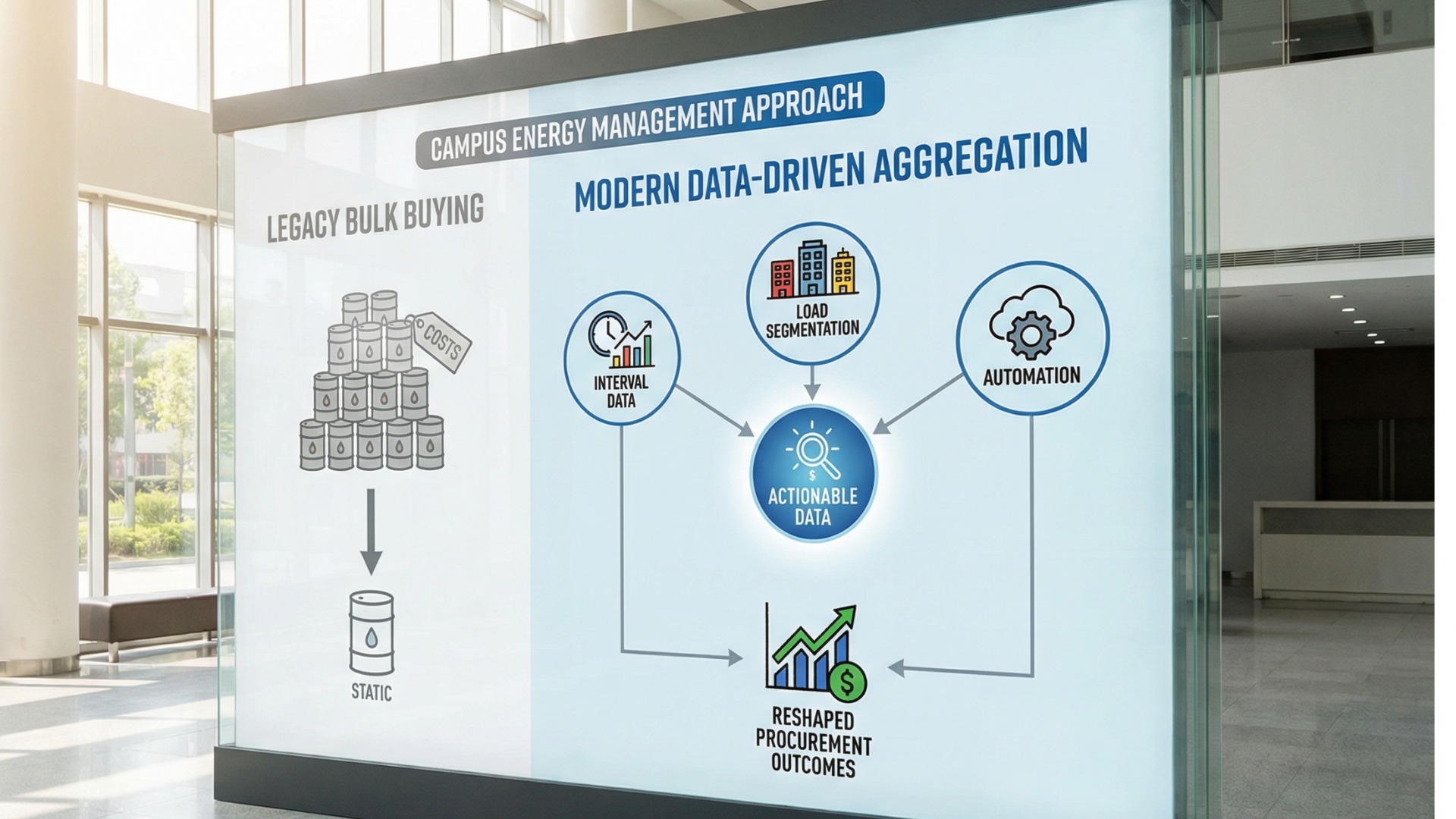
Using interval data and load profiles to segment participants
Interval data transforms a simple buying group into a managed energy portfolio. Districts with flatter load shapes or controlled peaks contribute stability that suppliers value. Those with volatile or summer-heavy loads can adopt tailored strategies such as flexible contracts or demand-response participation.
Through this segmentation, school district energy aggregation gains structure rather than volume alone. Each participant plays a defined role, leading to clear baselines, transparent pricing, and fair distribution of costs and benefits.
Time-of-use patterns, peak management, and capacity charges
Energy pricing often hinges on when electricity is consumed, not just how much. Time-of-use rates and capacity charges reward districts that shift or trim peaks during critical hours. Simple operational changes, adjusting HVAC schedules or managing charging stations—can directly influence contract economics.
Districts that analyze and refine their time-of-use patterns demonstrate control and predictability, giving suppliers confidence to bid more aggressively in K-12 electricity procurement events.
Integrating behind-the-meter resources (solar, storage, controls)
Behind-the-meter assets like solar arrays, battery storage, and smart controls extend the power of traditional aggregation. When properly modeled, they reduce exposure to demand spikes and volatile hours.
Integrating these systems into school district energy aggregation strategies builds flexibility and resilience. Each kilowatt-hour stored or shifted contributes to better group pricing, cleaner energy use, and improved fiscal outcomes over the long term.
Designing aggregation 2.0 for school districts
Aggregation 2.0 applies precision design to group energy procurement. Through careful participant screening, product differentiation, and analytics, districts turn data into negotiating strength. Each step aligns technical performance with financial priorities under effective campus energy management.
Districts ready to modernize must rethink roles, criteria, and expectations. Well-designed programs unify districts with complementary load shapes and clear commitments to operational transparency.
Eligibility criteria and participant expectations
A successful school district energy aggregation initiative defines who should join and what data must be shared. Participants must agree to consistent reporting standards and energy management practices.
This clarity helps suppliers trust the accuracy of group profiles. It also fosters accountability among members and prevents high-cost habits from eroding the group’s advantages during public sector energy bidding rounds.
Product structures tailored to different load types
Not all districts benefit equally from a single contract model. Some may prefer fixed-price stability, while others capture savings through indexed products or demand-response participation. Segmenting contracts by load behavior creates multiple pathways to value.
Advanced modeling under K-12 electricity procurement frameworks allows advisors to align each product with predictable performance metrics, ultimately creating balanced risk and reward across the group.

Governance and communication in aggregated programs
Strong governance keeps sophisticated energy aggregation programs on track. As campus energy management becomes more data-centric, roles and communications must evolve. Clear processes define responsibility, transparency, and stakeholder engagement, keeping programs credible with boards and taxpayers.
Consistent reporting also supports long-term confidence in shared savings and sustainability claims, helping public agencies manage accountability to their communities.
Roles of the lead agency, advisors, and districts
Effective governance depends on collaboration. The lead agency coordinates contracts and compliance, energy advisors interpret data, and participating districts execute operational adjustments.
In modern school district energy aggregation programs, these roles must be explicit and aligned. Everyone involved should understand how their actions influence bid outcomes, budget predictability, and supplier relationships within the broader public sector energy bidding framework.
Reporting and transparency to boards and taxpayers
Regular performance reporting builds trust and accountability. Dashboards that track group savings, emissions reductions, and operational improvements help districts communicate results confidently.
Public visibility also strengthens support for continued participation in K-12 electricity procurement programs. When taxpayers and board members see measurable outcomes, aggregation becomes a point of pride rather than a procedural exercise.
How Kb3 Advisors supports aggregation strategy and execution
Kb3 Advisors acts as the engine behind modern campus energy management initiatives for education and public-sector clients. The firm combines analytics, strategy, and bid execution to upgrade legacy aggregation into dynamic performance programs.
With tools that unify interval data, district profiles, and load projections, Kb3 builds precise procurement strategies that capture current market opportunities while sustaining long-term rate advantages.
Data aggregation and analytics
Kb3’s data platform integrates meter data, weather correlations, and facility schedules to map each district’s unique energy fingerprint. These insights reveal which districts strengthen or weaken the group load – information suppliers rarely see in basic aggregations.
Through advanced modeling, school district energy aggregation becomes an information advantage rather than a simple buying group. These analytics underpin all decisions, from bid timing to product selection.
Bid strategy, supplier negotiations, and ongoing monitoring
Kb3 Advisors manages the full spectrum of public sector energy bidding, from preparation through post-award analysis. Bid events incorporate granular data and supplier dialogue to refine contract terms.
After execution, Kb3 monitors performance and market trends, providing continuous feedback and strategy updates. This disciplined, data-driven process helps K-12 electricity procurement programs remain competitive even as market and operational conditions evolve.
District consortium leaders can request a feasibility assessment from Kb3 Advisors to explore how Aggregation 2.0 principles can upgrade their current energy programs.
Sources
- Energy Efficient and Healthy K-12 Public School Facilities… naseo.org. Accessed March 31, 2026.
- Electricity and Time-of-Use Pricing. illinois.edu. Accessed March 31, 2026.
- A Simple Way to Use Interval Data… aceee.org. Accessed March 31, 2026.
- School Solar Ownership Models: Federal Funding Opens New Opportunities. climateandcommunity.org. Accessed March 31, 2026.
- Aggregated Renewables Purchasing: 5 Key Questions, Answered. wri.org. Accessed March 31, 2026.
