

Energy procurement is often judged by the rate you secure. For many organizations, the bigger issue is what happens after the contract is signed. If energy costs are not accurately measured and allocated across tenants or departments, even the best procurement strategy can fall short of its expected financial impact. This is where many commercial real estate portfolios and large facilities start to see gaps between projected and realized savings.
For leaders responsible for financial performance, these gaps create ongoing challenges. Budget forecasts become less reliable, operating expenses are harder to control, and internal teams spend valuable time resolving billing discrepancies. When utility costs are shared or estimated, it becomes difficult to clearly demonstrate accountability or communicate performance to stakeholders and board members.
Submetering brings clarity to this process. It allows organizations to tie energy consumption directly to individual tenants or spaces, improving cost recovery and reducing disputes. More importantly, it provides a level of data transparency that supports better decision-making. With accurate usage insights, leaders can align energy procurement strategies with real demand patterns and identify opportunities for cost reduction.
For organizations balancing cost control, operational efficiency, and long-term growth, accurate tenant billing is more than a back-office function. It is a practical, scalable way to protect margins and strengthen confidence in financial reporting.
Why energy procurement fails without accurate submetering
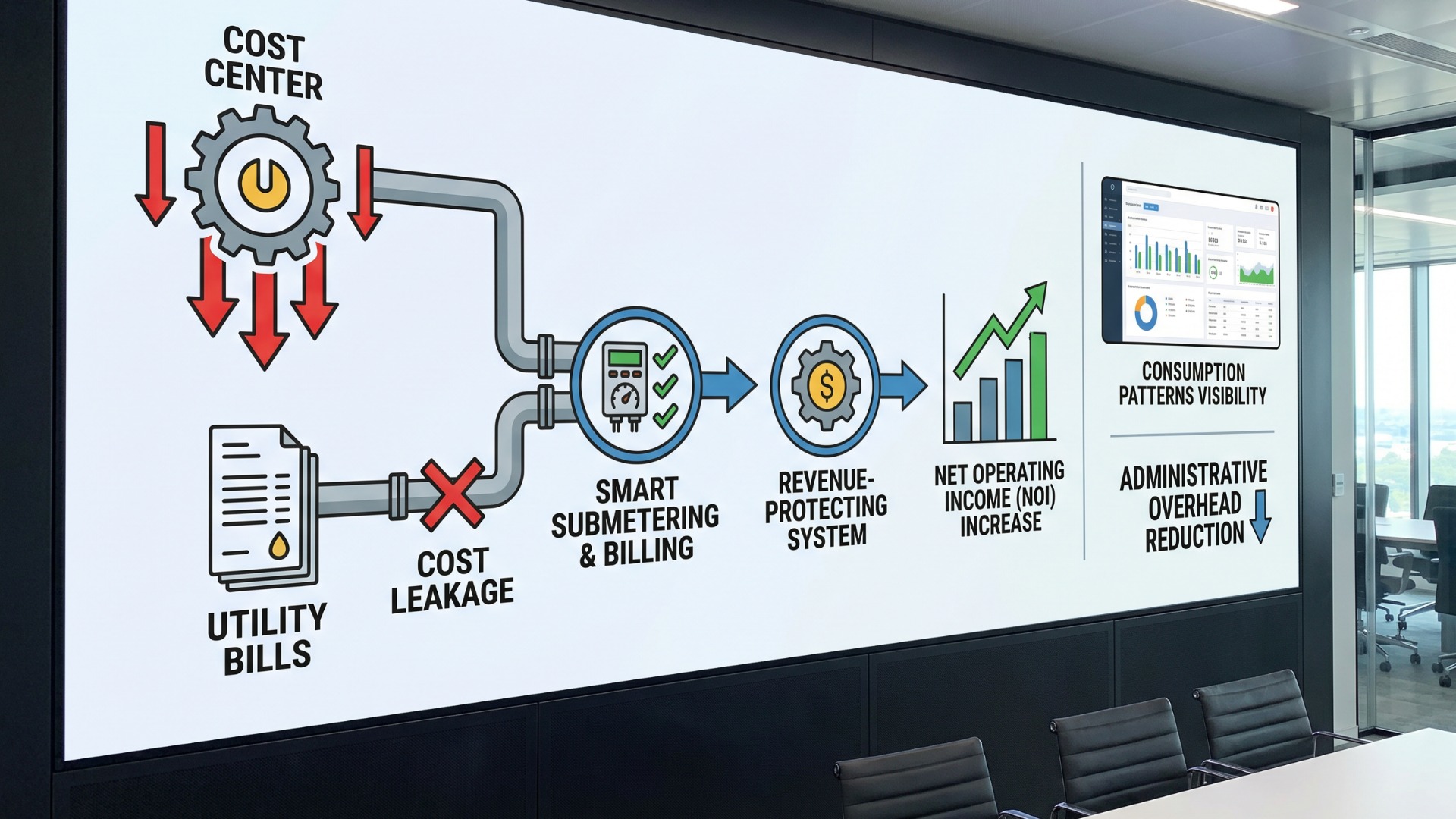
Many organizations assume that securing a competitive utility rate is enough to control costs. However, that assumption often breaks down in practice. When tenant usage is estimated or loosely allocated, gaps begin to form between what is paid and what is recovered. Over time, those gaps turn into persistent cost leakage that directly impacts net operating income.
Energy procurement plays a central role in cost control, yet its value is limited when consumption data lacks precision. Without submetering, property managers rely on averages or square footage allocations that rarely reflect actual usage patterns. This creates inequities among tenants and makes it difficult to defend billing decisions.
The issue extends beyond financial loss. Inaccurate billing introduces friction with tenants, increases disputes, and adds administrative strain on already stretched teams. Leaders then face challenges when reporting performance to executives who expect clear, data-backed outcomes.
A more accurate measurement framework closes these gaps. It connects procurement strategy to real consumption, allowing organizations to capture the full financial benefit of their energy decisions.
The financial impact of transparent tenant energy billing
When billing aligns with actual usage, the financial benefits become immediately visible. Transparent systems replace estimates with precise data, improving cost recovery and reducing revenue loss across multi-tenant properties. For decision-makers under pressure to control expenses, this shift can make a measurable difference within a short time frame.
Energy procurement outcomes improve when billing accuracy supports the original cost assumptions. If tenants are underbilled due to shared or misallocated utilities, the organization absorbs those costs. Transparent billing corrects this imbalance and strengthens overall financial performance.
There are also operational gains. Clear, consistent billing reduces disputes and shortens resolution cycles, which frees up internal resources. Finance and operations teams can spend less time correcting errors and more time focusing on strategic initiatives.
From a reporting standpoint, accurate billing provides stronger data for forecasting and performance tracking. Leaders gain confidence in their numbers and can communicate results more effectively to stakeholders who expect accountability and clarity.
Core components of an effective submetering strategy
A successful submetering approach depends on more than installing equipment. It requires a coordinated system that captures, validates, and translates consumption data into actionable insights. Without that structure, even advanced meters can fall short of delivering meaningful results.
Energy procurement strategies benefit when submetering systems provide accurate and timely data. Advanced meters or submeters collect detailed usage information at the tenant or equipment level. That data must then flow into a centralized platform where it can be reviewed, validated, and prepared for billing.
Integration is another key component. Billing systems should align with lease terms and regulatory requirements, which reduces the risk of compliance issues. Automation plays an important role in maintaining consistency and minimizing manual intervention.
Scalability is also critical for organizations with multiple properties. A standardized framework allows teams to replicate success across locations without rebuilding processes from scratch. This creates a foundation for long-term efficiency and supports more informed decision-making at every level of the organization.
Integrating submetering into a broader energy procurement strategy
Submetering becomes far more valuable when it is connected to a larger operational strategy. Instead of treating it as a standalone tool, organizations can use it to refine how energy is purchased, allocated, and managed over time. This connection creates a feedback loop that strengthens decision-making.
Energy procurement improves when real consumption data informs contract strategies and supplier negotiations. Tenant-level insights reveal usage trends, peak demand periods, and inefficiencies that would otherwise remain hidden. With this information, leaders can pursue pricing structures that better align with actual demand.
There are also opportunities to support sustainability goals. Detailed consumption data helps identify areas where efficiency improvements can reduce overall usage. This supports environmental initiatives while contributing to cost control.
For organizations focused on growth, integration provides consistency across expanding portfolios. It aligns financial planning with operational realities and creates a more predictable cost structure. This level of coordination helps leadership teams make strategic decisions with greater confidence and clarity.
Reducing administrative burden through automation
Manual processes often create bottlenecks that slow down operations and introduce errors. Teams managing utility data across multiple tenants can quickly become overwhelmed with spreadsheets, reconciliations, and invoice corrections. This not only increases workload but also limits the ability to focus on higher-value activities.
Energy procurement performance suffers when administrative inefficiencies interfere with accurate cost tracking. Automated systems streamline data collection, validation, and billing, which reduces the need for manual intervention. This leads to faster turnaround times and more consistent results.
Automation also improves communication with tenants. Clear, timely invoices reduce confusion and minimize disputes, which saves time for property and finance teams. Instead of reacting to issues, teams can operate with a more proactive approach.
Third-party advisors can support this transition by implementing systems that align with organizational goals. With the right framework in place, internal teams gain time, reduce risk, and improve overall efficiency without adding unnecessary complexity to their workflows.
From cost leakage to revenue protection
Consider a multi-tenant office building where utility costs were allocated based on square footage. Over time, tenants with lower usage subsidized those with higher demand, creating dissatisfaction and reduced cost recovery. Management teams spent significant time addressing billing concerns without resolving the underlying issue.
Energy procurement appeared effective on paper, but the lack of accurate allocation masked the true financial picture. Once submetering was introduced, the organization gained visibility into actual consumption at the tenant level. Billing shifted from estimates to precise calculations, which improved fairness and transparency.
The results were measurable within the first year. Cost recovery increased, billing disputes declined, and administrative workload decreased. Leadership also gained clearer insight into energy usage trends, which supported more informed planning.
This type of transformation highlights how accurate measurement and billing can turn a persistent problem into a structured, revenue-protecting system that supports long-term financial performance.

Key considerations before implementation
Adopting a submetering strategy requires thoughtful planning and a clear understanding of potential challenges. While the long-term benefits are compelling, organizations must evaluate their current infrastructure, financial goals, and operational capacity before moving forward.
Energy procurement strategies should be aligned with any submetering investment. Leaders need to assess how improved data will support cost control, forecasting, and reporting objectives. This helps build a strong business case that resonates with stakeholders and decision-makers.
Upfront costs are another factor to consider. Equipment, installation, and system integration require investment, but these costs should be weighed against the potential for improved cost recovery and reduced administrative burden.
Lease structures and regulatory requirements also play a role. Organizations must confirm that billing practices align with legal and contractual obligations. Selecting the right advisory partner can simplify this process and reduce implementation risk.
A well-planned approach sets the stage for success and positions the organization to capture long-term value from improved measurement and billing practices.
Strengthen your financial performance
Organizations often need expert guidance to connect technical solutions with financial outcomes. Kb3 Advisors brings deep market knowledge and a structured approach that helps clients move from concept to execution with confidence. Our focus remains on delivering measurable results that align with business priorities.
Energy procurement becomes more effective when supported by accurate data and transparent reporting. Kb3 Advisors works with clients to design submetering and billing frameworks that improve cost recovery and provide clear visibility into performance. The result is a more controlled, efficient system that supports financial stability and positions clients for long-term success.
Sources
- Data Access: A Fundamental Element for Benchmarking and Building Performance Standards. epa.gov. Accessed June 8, 2026.
- Submetering. gsa.gov. Accessed June 8, 2026.
- Submetering Resources – Commercial Buildings. betterbuildingssolutioncenter.energy.gov. Accessed June 8, 2026.
