

Energy contract oversight for gyms creates a level of control and predictability that a single quote can never deliver. Multi-location fitness chains depend on electricity and natural gas to run every site, which means their contracts sit at the heart of margin protection, risk management, and long-term planning.
Most gym and fitness chains treat energy procurement as a one-time event. Someone requests a quote, picks a supplier, signs the agreement, and moves on to the next operational priority. The contract then disappears into a file until a renewal date quietly approaches. This pattern introduces hidden risk that grows with every location added to the portfolio. When contracts renew at the wrong time or roll into unfavorable terms, the impact hits margins and cash flow, often without a clear explanation.
A different mindset treats each energy contract as a living asset that requires continuous oversight. This includes renewal tracking, supplier management, and ongoing review of terms and performance. Gym chains that adopt this approach create a more stable energy cost structure, gain better negotiation power, and align their contracts with business goals rather than leaving outcomes to chance.
Why energy contracts require more than a single quote
Energy costs represent a major operating expense for gyms, especially those with multiple sites. Lighting, HVAC, pools, saunas, and extensive operating hours drive meaningful electricity and natural gas spend. It might feel efficient to chase a low rate once and assume the job is done. In practice, this approach leaves a lot of value on the table and exposes the organization to avoidable risk.
“A single quote, even if it looks competitive, only reflects one moment in time. It doesn’t account for how market prices might change before the contract expires,” said Justin Vissat, Kb3 Advisors managing partner. “It doesn’t address how the supplier will perform in billing, customer service, or data access. Those things are important.”
For a multi-location operator, each site adds complexity, Vissat said. Multiple contract terms, different start and end dates, varied supplier relationships, and changing usage patterns all interact with financial performance. Treating these decisions as isolated events turns procurement into a series of disconnected transactions. “A structured program of energy contract oversight for gyms replaces guesswork with a coordinated strategy,” he said. “This strategy recognizes that contracts reflect ongoing commitments that shape financial results across the entire portfolio.”
The role of energy contract oversight for gyms
Energy contract oversight for gyms means more than keeping contracts in a folder. It involves managing every agreement as part of a larger financial and operational picture. This oversight integrates contract details, market information, and business plans to support better decisions throughout the life of each contract.
Continuous oversight starts with visibility. Gym chains need a complete view of current suppliers, contract terms, pricing structures, expiration dates, and any special clauses such as volume commitments. Without this information in one place, teams work from memory or scattered documents, leading to missed opportunities and other surprises.
Once teams establish visibility, oversight shifts into active management. Advisors and internal leaders monitor how each contract performs against expectations. They track whether rates stay competitive relative to current market conditions. They review whether terms still match operational realities, such as changes in operating hours, new equipment, or added locations. They also use this information to inform budget forecasting and renewal strategy.
This level of attention creates tangible benefits. Margins improve when contracts align with usage patterns and market signals. “Planning becomes more reliable because energy costs follow a clearer path,” said Vissat. “Supplier relationships become easier to manage because expectations and performance stay in focus. Oversight turns energy procurement into a strategic function that supports growth.”
Renewal tracking and the cost of missed deadlines
Renewal tracking sits at the core of effective contract oversight. Missing a renewal window can cost a gym chain far more than the time saved by avoiding a review. Many suppliers include provisions that trigger default pricing if customers do not act by a certain date.
This risk grows sharper when a chain operates multiple locations, Vissat said. “Each site might have a different contract start date, term length, and supplier. Without a central system, renewals scatter across the calendar. Busy staff focus on day-to-day operations and trust that someone will catch each expiration. That doesn’t always happen.”
Renewal tracking solves this problem with structure. Gym chains build a centralized calendar that lists every contract, supplier, and expiration date across the portfolio. They assign responsibility for monitoring these dates and initiating conversations well before each contract ends. Ideally, they begin reviewing six to 12 months ahead of time, giving advisors and internal teams room to study market conditions, assess performance, and craft a strategy.
When chains track renewals proactively, they avoid defaults and gain leverage. They can plan portfolio-wide moves, such as aligning terms across locations or staggering renewals to reduce exposure in any single market window. A regional fitness chain with 10 sites might, for example, identify that four contracts expire within a short period during a high-price season. With advance notice, the advisor can evaluate options such as early renewal at better rates or restructuring terms to spread risk over time.
Supplier management beyond rate shopping
Supplier management extends far beyond the initial rate comparison. A supplier touches many aspects of a gym chain’s operations, from invoice accuracy to customer service and data access. Treating supplier relationships as static or purely price-focused overlooks these daily interactions that shape how energy costs show up on the balance sheet.
When gym chains engage in active supplier management, they monitor billing for errors and unusual charges. This includes checking demand charges, pass-through fees, and any variable components that might fluctuate over time, Vissat said. They pay attention to the clarity and detail of invoices, which can affect how quickly finance teams reconcile accounts and identify issues.
Supplier management also includes evaluating responsiveness. When questions arise, operators need timely answers. Chains benefit when suppliers provide easy access to usage data and tools that support analysis. These capabilities matter for budget forecasting, efficiency projects, and sustainability initiatives that rely on accurate information.
A long-term energy procurement advisor plays an important role in supplier management, especially for multi-location portfolios. Advisors act as a central point of contact who engages suppliers on behalf of the client. They address billing discrepancies, negotiate better terms where performance falls short, and provide the chain with a single source of insight across all suppliers. “This frees internal teams from chasing multiple contacts and allows them to focus on operational priorities,” said Vissat.
Ongoing contract review as a risk management tool
Ongoing contract review treats contracts as dynamic agreements that must stay aligned with reality. Energy usage patterns change as gyms add locations, modify operating hours, or invest in new equipment. Market conditions move in cycles. Business strategies evolve. Contracts that fit perfectly at signing might fit less well two years into the term.
Risk management depends on detecting these shifts. Regular contract reviews examine whether the structure of each agreement still matches how the chain operates. This includes looking at volume commitments, swing tolerances, pass-through components, and any performance guarantees. “Ask whether a fixed rate still makes sense, whether a more flexible structure might reduce risk, or whether efficiency gains have changed the profile enough to warrant renegotiation,” said Vissat.
Ongoing review also checks alignment with budget forecasts and expansion plans. If the chain plans to add several locations in the next year, contract terms that restrict volume changes might hinder growth. If the organization pursues sustainability goals, such as adding renewable-backed supply or on-site generation, existing contracts might need adjustments to support those initiatives.
Treating contract review as a recurring discipline rather than a one-time legal check strengthens risk management. Gym chains stay ahead of potential conflicts, hidden costs, and structural mismatches. They enter renewal discussions with a clear view of what worked, what did not, and what they want from the next agreement. Ongoing review turns contracts into tools that support strategy rather than constraints that limit options.
Why continuous oversight outperforms one-time quotes
Continuous oversight provides a more powerful path to value than one-time quotes because it captures the full life cycle of each contract. A quote only speaks to the starting point. Oversight covers every stage, from execution to renewal and beyond.
With continuous oversight, gym chains time renewals based on market signals instead of rigid calendar habits. They build negotiating power through data, performance history, and portfolio-wide visibility. They discover issues early, such as billing errors or contract clauses that no longer serve the organization, rather than dealing with them only when a problem becomes severe.
The benefits compound across locations and years. Small improvements in each contract, such as correcting misaligned terms, add up to meaningful savings and a smoother cost profile over time. More importantly, operators gain confidence that energy agreements support their goals for growth, member experience, and financial performance.
A transactional broker who focuses on finding a low rate once can’t deliver this level of value. Continuous oversight belongs to energy advisors and internal leaders who view energy contracts as part of a strategic framework. They build systems and processes that keep contracts visible, under review, and aligned with the direction of the business.
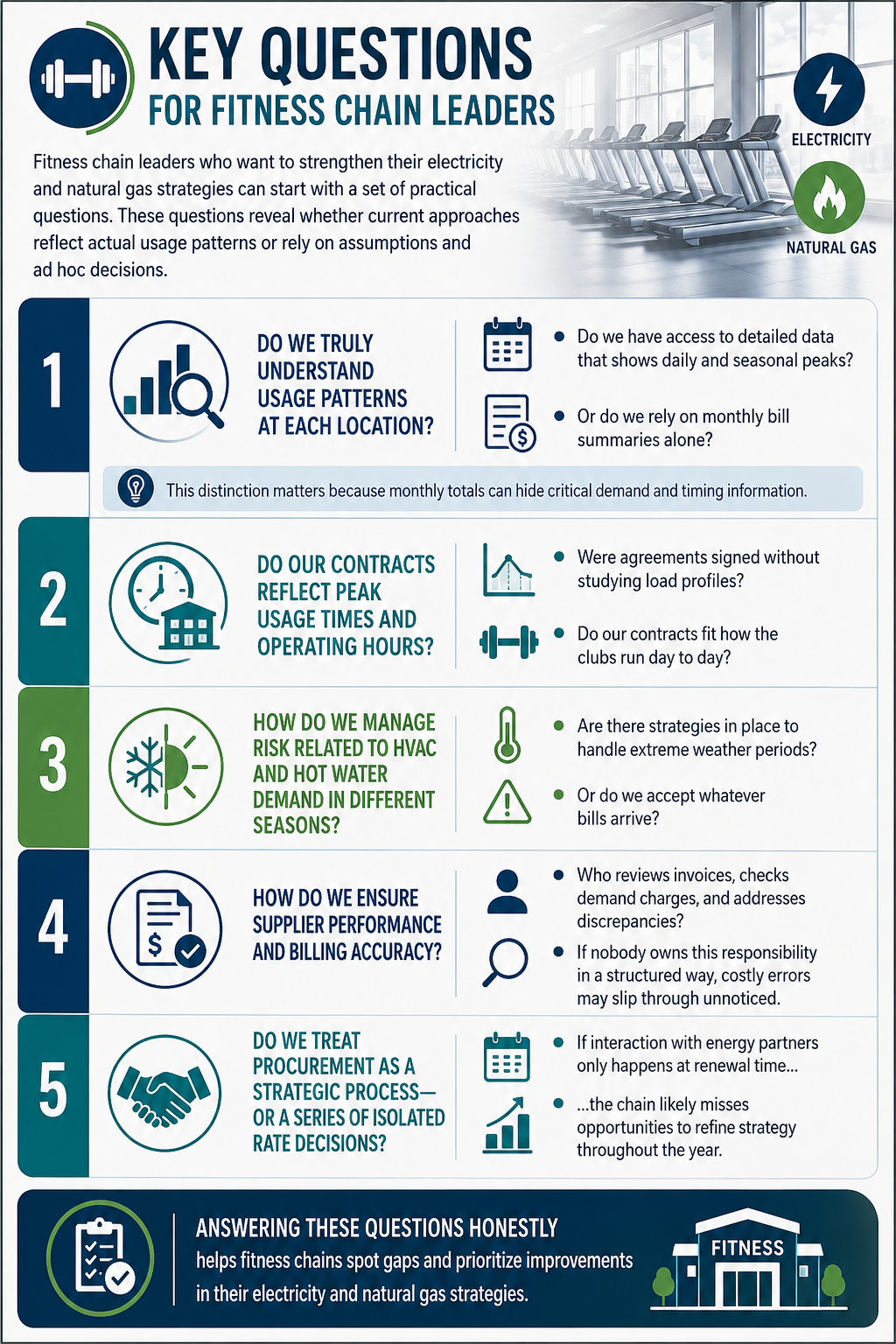
Key questions gym leaders should ask about their energy contracts
Gym leaders who want to strengthen their contract oversight can begin with a simple set of questions. These questions create clarity about current practices and reveal where risk might hide in daily operations.
First, ask whether all contract details sit in one central place. If expiration dates and supplier contacts live in different inboxes and spreadsheets, visibility likely needs improvement.
Leaders should also examine how often they review supplier performance and invoices. Sporadic checks leave room for errors and misaligned charges. Regular review helps catch issues early. Another important question focuses on alignment between contracts and business plans. If the organization expects significant growth or efficiency investments, existing terms might not support those moves.
Finally, consider whether energy procurement feels like a series of isolated decisions or part of a continuous advisory relationship. If the team only hears from a broker when a contract expires, they likely miss the benefits of ongoing insight. Recognizing this gap opens the door to a more strategic approach.
Take control of your energy contracts with Kb3 Advisors
Energy contracts for gym and fitness chains carry far more value than a single rate on signing day. Continuous oversight turns those contracts into tools that protect margins, support growth, and reduce risk across a multi-location portfolio. Renewal tracking, supplier management, and ongoing contract review together create a disciplined framework that outperforms one-time quote shopping.
Kb3 Advisors can help you build a stronger program for energy contract oversight for gyms by mapping your portfolio, reviewing existing contracts, highlighting renewal risk, and assessing supplier performance. The Kb3 team uses that data to design an oversight strategy that aligns contracts with your financial objectives and operational realities across every site.
Connect today if you’re ready to move beyond one-time quotes and treat energy agreements as strategic assets. Schedule a portfolio review and start building a contract oversight program that keeps your gym or fitness chain in control of its energy costs, strengthens margins, and supports long-term growth.
