
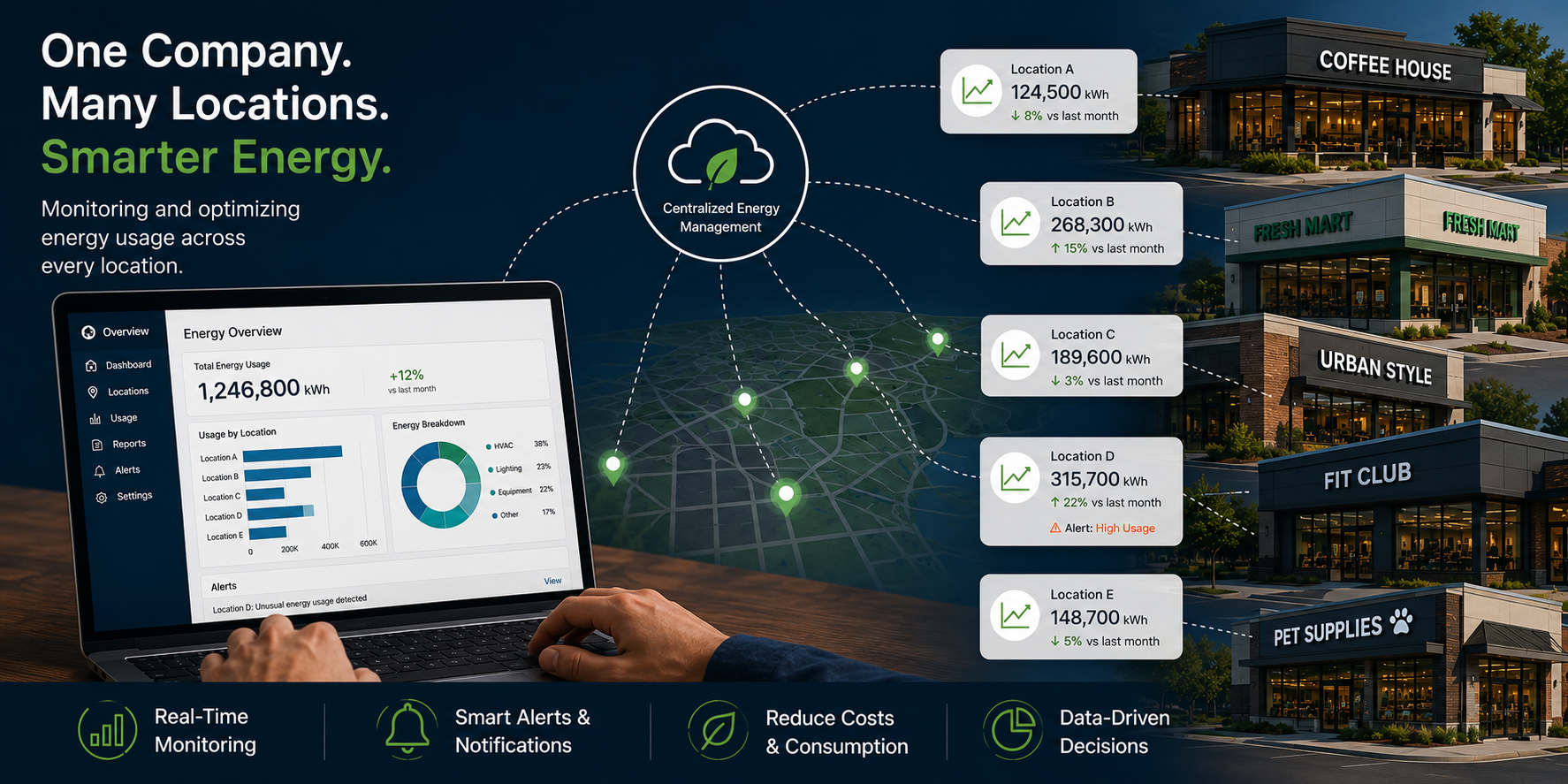
The energy procurement maturity model is difference between reacting to surprise renewal notices and leading with confidence as your portfolio grows. Most retail chains and multi-location businesses manage energy like a fragmented afterthought – until a rate spike hits the P&L or an auto-renewal locks in unfavorable terms across dozens of sites. You might have a trusted broker who handles individual contracts, but that approach leaves you exposed to inconsistent rates, missed savings opportunities, and zero visibility into what’s happening across your entire portfolio.
Energy procurement for multi-location organizations requires a different playbook. It demands centralized data, strategic planning, and a long-term advisory partnership rather than transactional deal-making. This maturity model helps you diagnose where your organization stands today and what it takes to move from reactive to strategic.
Whether you’re a CFO trying to stabilize budget variance or a facilities director drowning in utility invoices, understanding your current stage is the first step toward meaningful improvement.
Why energy procurement maturity matters for multi-location organizations
Procurement maturity measures how well your organization manages energy across all locations, from data collection to decision-making to long-term strategy. For multi-site businesses, this concept carries extra weight because the complexity of managing dozens or hundreds of locations multiplies the risk of costly mistakes. Organizations at higher maturity stages achieve better cost predictability and lower total energy costs compared to those stuck in reactive modes. Research shows that companies with advanced energy management practices can reduce budget variance by up to 25% while capturing an additional 20% in savings through strategic procurement and demand management.
The business impact extends far beyond the utility bill. Mature energy procurement supports net operating income by stabilizing one of the largest controllable operating expenses. It strengthens ESG credibility when renewable procurement and carbon reduction become board-level priorities. It reduces operational risk by identifying billing errors and anticipating market volatility before it impacts your bottom line. For retail chains and other distributed businesses, energy procurement maturity also enables scalable growth. You can’t open new locations effectively if your energy management approach can’t handle portfolio complexity.
The 5-stage energy procurement maturity model
This model breaks down energy procurement capability into five distinct stages, each with its own characteristics, pain points, and requirements for advancement. Think of it as a roadmap that helps you understand where you are, where you want to go, and what it takes to get there. The stages progress from fragmented and reactive at the lowest level to enterprise energy intelligence at the highest. Most retail chains and multi-location businesses operate between stages one and three, which means there’s substantial room for improvement.
Stage 1: Fragmented and Reactive
Stage one represents the starting point for many multi-location organizations. Energy decisions happen site by site, often driven by renewal notices rather than strategic planning. There’s no central database of contracts, rates, or usage data. Each location might have a different supplier, different rate structure, and different renewal timeline. Finance teams discover auto-renewals after they’ve already locked in, and facilities directors spend countless hours manually tracking invoices across multiple utility portals.
The pain points at this stage are severe and costly. Surprise renewals catch leadership off guard. Inconsistent rates across similar locations create internal equity issues and missed benchmarking opportunities. There’s no visibility into portfolio-wide spend, making budget forecasting nearly impossible. Manual invoice chaos consumes administrative resources and increases the risk of errors going undetected. Broker relationships tend to be transactional, with little continuity or strategic guidance. Decision-making is reactive, driven by urgency rather than market intelligence.
Moving beyond stage one requires a fundamental shift in how you approach energy management. You need to centralize your data, create a renewal calendar, and establish basic visibility into what’s happening across your portfolio. This doesn’t require expensive software or a large internal team. It requires commitment to treating energy as a managed portfolio rather than a collection of individual utility accounts.
Stage 2: Centralized Data
Stage two marks the transition from chaos to control. Organizations at this level have aggregated billing and usage data across all locations. They can generate basic dashboards showing portfolio-wide spend, consumption patterns, and renewal timelines. There’s a single source of truth for contract terms, rates, and meter information. This centralization enables better supplier negotiations and more accurate budget forecasting.
The characteristics of stage two include systematic data collection, standardized reporting formats, and a dedicated person or team responsible for energy management. Renewal tracking becomes proactive rather than reactive. Basic analytics reveal outliers and opportunities for standardization. Some organizations begin aligning renewal dates to create purchasing leverage, though strategic timing decisions may still be limited.
Despite these improvements, stage two organizations remain largely reactive. They have visibility but lack forward-looking strategies. Analytics are descriptive rather than predictive. There’s limited integration with broader financial planning or sustainability goals. Supplier diversification may be minimal, leaving the organization exposed to counterparty risk. Moving to stage three requires developing a multi-year procurement roadmap, implementing layered purchasing strategies, and building market intelligence capabilities that inform timing and structure decisions.
Stage 3: Strategic Procurement
Stage three represents a significant leap in capability and impact. Organizations at this level operate with a multi-year procurement roadmap that aligns contract renewals, purchasing timelines, and budget forecasts. They use layered purchasing strategies like block and index to balance cost certainty with flexibility. Supplier portfolios are diversified across multiple providers to mitigate risk and maintain competitive pressure.
The hallmarks of stage three include proactive market monitoring, scenario modeling for different purchasing approaches, and integration of energy procurement into broader financial planning. Budget forecasts extend 36 months or more, accounting for capacity charges, demand response opportunities, and regional market dynamics. Analytics move from descriptive to predictive, helping leadership anticipate volatility rather than simply react to it.
Pain points at this stage often revolve around execution complexity and resource constraints. Maintaining a sophisticated procurement strategy requires dedicated expertise and robust data infrastructure. Some organizations struggle to keep pace with market changes or lack internal bandwidth to optimize every decision. ESG integration may be limited, with renewable procurement treated as a separate initiative rather than part of the overall strategy. Advancing to stage four requires integrating renewables, implementing advanced analytics, and connecting energy decisions to enterprise-level outcomes.
Stage 4: Optimized and Integrated
Stage four organizations have achieved full portfolio visibility, automated reporting, and seamless integration of renewable procurement into their overall strategy. They participate in demand response programs, optimize load profiles, and use advanced analytics to identify savings opportunities that less mature organizations miss entirely. Energy procurement is no longer a back-office function but a strategic capability that supports broader business objectives.
The characteristics of stage four include real-time dashboards, automated anomaly detection, and proactive contract management that capture market opportunities. Renewable procurement through PPAs, RECs, or green tariffs is layered into the roadmap without sacrificing budget discipline. There’s strong alignment between energy strategy and ESG goals, with clear metrics tracking progress on carbon reduction and sustainability commitments.
Despite these capabilities, stage four organizations may still operate in silos. Energy procurement is optimized but not fully connected to enterprise risk management, net operating income planning, or board-level reporting. Moving to stage five requires breaking down these remaining barriers and positioning energy intelligence as a strategic lever that drives enterprise value.
Stage 5: Enterprise Energy Intelligence
Stage five represents best-in-class performance. Energy procurement is fully integrated into enterprise strategy, with real-time analytics, scenario modeling, and board-level reporting. Leadership treats energy as a strategic asset that drives competitive advantage, not just a cost to minimize. Decisions are informed by sophisticated market intelligence, and the organization continuously innovates to capture emerging opportunities.
Organizations at this level have dedicated energy strategy teams, advanced analytics platforms, and strong partnerships with advisory firms that provide ongoing market guidance. They participate in emerging markets like distributed energy resources and virtual power plants. Risk management extends beyond price hedging to include counterparty risk, regulatory compliance, and climate-related scenario planning.
Few multi-location businesses operate at stage five today. Those that do gain measurable advantages. They achieve superior cost performance, stronger ESG credentials, and greater resilience to market volatility. They also position themselves as leaders in their industries, attracting investors and customers who value sustainability and operational excellence.
Determining where your organization stands
You can gauge your current maturity level by answering a few key questions about your energy management approach. Do you have a centralized database of all energy contracts and renewal dates across your entire portfolio? Can you generate a portfolio-wide report on energy spend and consumption within 24 hours without manual data gathering? Is your energy procurement strategy aligned with a three-year or longer financial plan? Do you actively diversify suppliers and use layered purchasing strategies to manage risk? Can you integrate renewable procurement into your existing contracts without compromising budget certainty?
If you answered no to most of these questions, you’re likely operating at stage one or two. If you have centralized data but lack strategic planning, you’re probably at stage two. If you have a multi-year roadmap but haven’t integrated renewables or advanced analytics, you’re at stage three. Organizations that have achieved full visibility, automated reporting, and seamless renewable integration are at stage four. Those treating energy as a strategic enterprise lever with board-level reporting have reached stage five.
Take the next step toward energy procurement maturity
Energy procurement maturity involves continuous improvement and strategic alignment. Organizations that advance even one stage can unlock significant cost savings, reduce risk, and improve executive confidence. The question is whether you can afford not to advance.
If this framework resonated with you, you’re ready to take the next step. Schedule a 30-minute consultation with Kb3 Advisors to discuss your specific challenges and opportunities. We’ll review your current approach, identify gaps, and outline a path forward that aligns with your business goals.
Don’t let another rate spike catch you off guard. Take control of your energy procurement today and position your organization for long-term success.
Sources
- 2018 Commercial Buildings Energy Consumption Survey final results. eia.gov. Accessed July 30, 2026.
- DOE 500001 Ready Program. energy.gov. Accessed July 30, 2026.
- Towards an energy management maturity model. researchgate.net. Accessed July 30, 2026.
